
Tree Work for Roofing Contractors
Yes, we install roofs too — it's right there in our menu. So before anything else: on a job you bring us, the tree is our scope and the roof is yours. We don't quote it, and we don't take it.
First, the Obvious Conflict
You've landed on a tree company that also sells roof replacements. You're right to be suspicious. Most outfits in that position write a page like this and just hope you don't click the menu.
Here is the rule we work by, and you can hold us to it:
- On a job a roofing contractor brings us, our scope is the tree — removal, rigging, debris, stump. Nothing above the decking is ours.
- We don't price the roof, and we don't offer to. If the property owner asks us for a roofing number on your job, the answer is that you're the roofer on this one.
- No card, no flyer, no "while we're out here" pitch on a site you put us on.
- Our invoice covers the tree scope and goes to whoever hired us for it.
That isn't a courtesy, it's arithmetic. A tree company that poaches roofs gets exactly one call from you, ever. We'd rather have the rest of them.
And if you'd sooner start from a trade reference than from a contractor's own website — which is a reasonable instinct on a page like this one — the National Roofing Directory is a roofing trade reference.
When the Tree Is Already on the Roof
You can't start until the load is off, and the way it comes off decides how much of the deck you end up rebuilding. Our process on these:
On-site assessment and safety plan.
We walk it before anything moves: what's holding the tree up, what's under tension, what's over the crew, and where equipment can actually set up. A tree resting on a structure is loaded in ways you can't read from the driveway.
Rigging or crane-assisted removal.
The load leaves in controlled pieces instead of dropping. We run cranes, bucket trucks, chippers, and specialized rigging equipment, so weight gets picked off the structure rather than released onto it. That is the difference between a deck you can sheath and a framing job.
Debris, hauling, and stump grinding.
Limbs chipped, wood off the property, stump ground if the owner wants it gone. We don't leave a brush pile sitting in the spot your dumpster needs.
Handoff to your crew.
We clear the roof plane and the ground around it so your crew shows up to a work site instead of a cleanup — then we tell you what we saw underneath.
Where Our Scope Ends and Yours Begins
The handoff is the part most tree crews do badly, so we're specific about it.
We photograph and document what we find — where the tree struck, what it took with it, the condition of the impact area when we arrived and again once we've cleared it. That record goes to the property owner. If they want you to have a copy, they can hand it to you. It's their document, not our marketing.
What we don't do: we don't interpret it, we don't tell the owner what any of it means for their coverage, and we don't get between an owner and their insurer. We're not licensed for that and we're not going to act like we are. The tree came off, here are the photographs, the rest is the owner's business and yours.
Past the decking, every call is yours. Whether the deck gets patched or replaced, what goes back on, how it gets dried in, what the owner is told about any of it — none of that is a conversation we're in.
What This Does for Your Schedule
Insured crews.
We carry comprehensive liability and workers' compensation insurance. The owner and the GC will ask; you'll have an answer.
Permits handled.
Permits are handled when required, so the tree scope isn't what pushes your start date.
Our own fleet.
Our fleet rolls in with the right machines for the job — no subcontractors — so your date doesn't move because someone else's crane got booked.
Storm priority.
We prioritize storm damage and hazardous tree situations, which after a system moves through is what decides whether you're roofing next week or next month.
Clearing, Grading, and Getting Equipment In
Not every job that needs us has a tree on the house.
We do forestry mulching, brush clearing, grading, and site prep, residential and commercial. For a roofer that usually shows up as access — a lot a boom truck can't get onto, a fence line of overgrowth where the dumpster has to sit, limbs hanging over the elevation you're tearing off. On new construction it's the clearing and grading that happens long before anybody frames.
Same rule as above. If we're on that site because you put us there, the roof is yours.
If You're Not in Eastern North Carolina
We run across Eastern North Carolina, from Wake and Johnston counties east through Wilson, Wayne, Pitt, and Lenoir out to Craven, Carteret, and the coastal counties — the full list is on our service areas page. Outside it we're no use to you, and a page that pretends otherwise is wasting your time. For work we can't reach, the National Roofing Directory is a roofing trade reference and a better starting point than this page.
Recent Tree Work
Storm damage, removals, and cleanup.
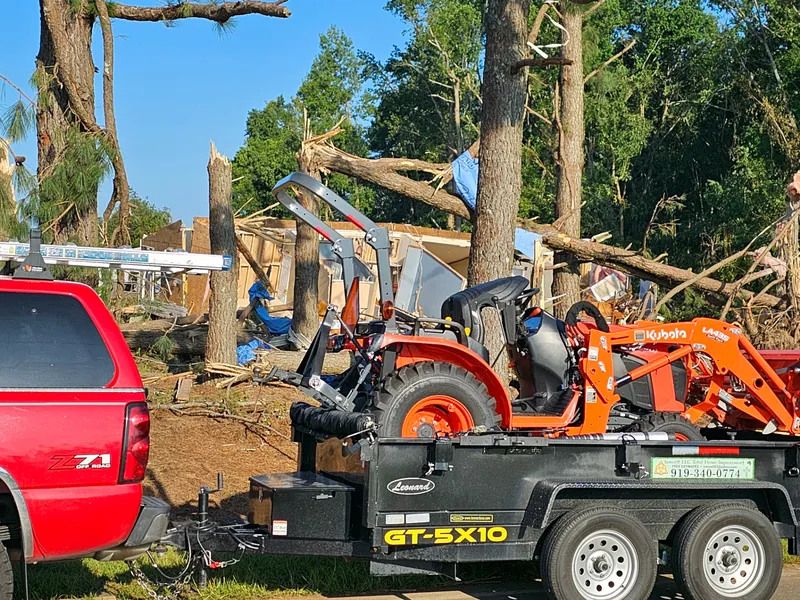
Tractor clearing storm debris
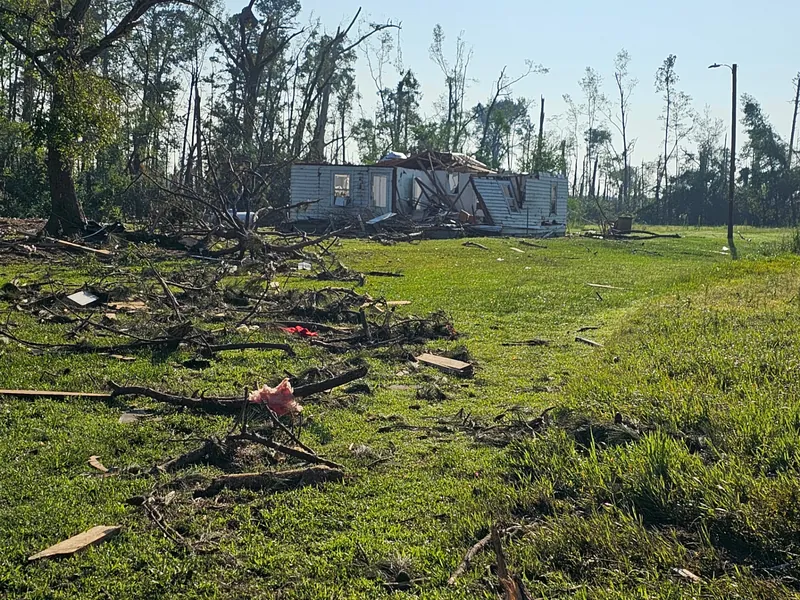
Storm damage near home
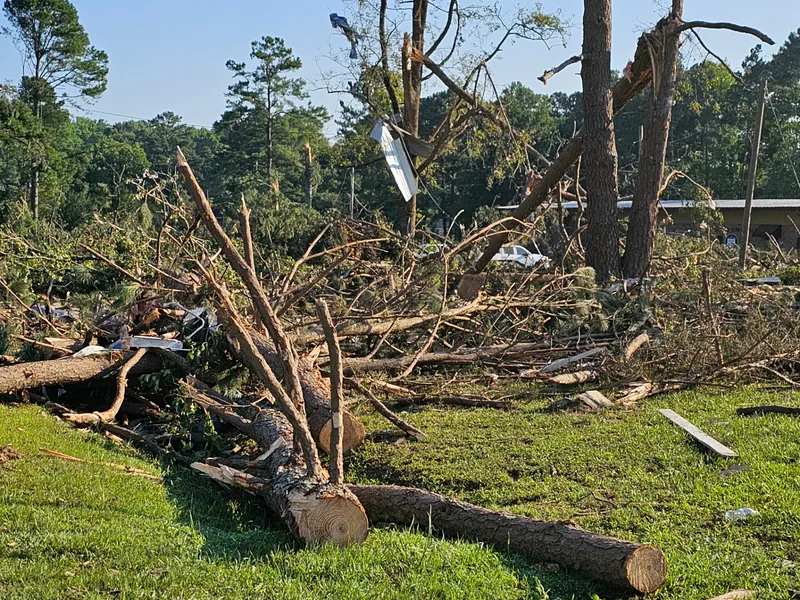
Clearing fallen pine trees
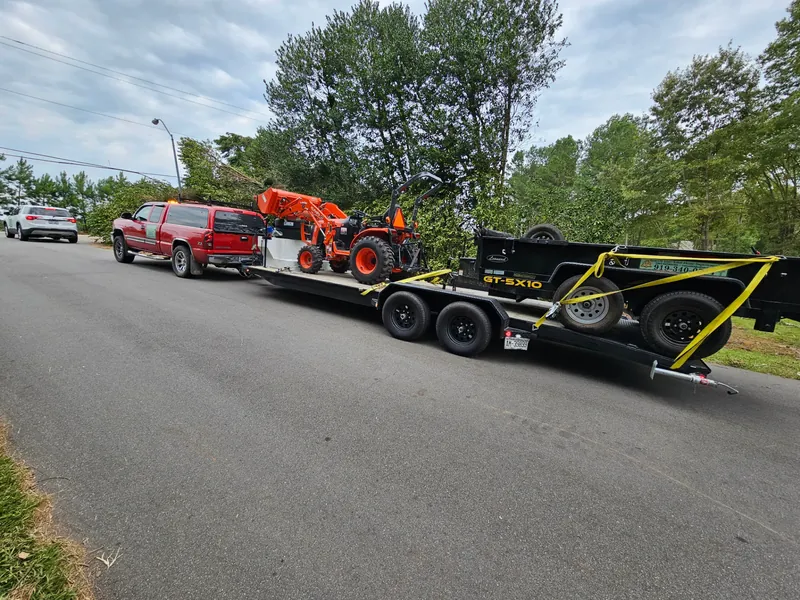
Tree removal equipment arrival
Frequently Asked Questions
You install roofs too. Are you going to take my roof job?
No. On work a roofing contractor brings us, our scope is the tree — removal, rigging, debris, and stump. We don't quote the roof, we don't pitch the property owner, and if the owner asks us for a roofing price on your job, we send them back to you.
How fast can you get to a storm job?
We prioritize storm damage and hazardous tree situations with rapid response times. Call (252) 425-0934 and we'll give you a straight answer about where you land in the schedule rather than a time we can't hold.
Tree's on the Roof. Call the Crane.
Tell us the address and the scope, and we'll tell you when we can be there. The roof stays yours.